I. About Solmax
Solmax is a world leader in sustainable construction solutions, for civil and environmental infrastructure. Its pioneering products separate, contain, filter, drain and reinforce essential applications in a more sustainable way – making the world a better place. The company was founded in 1981, and has grown through the acquisition of GSE, TenCate Geosynthetics and Propex. It is now the largest geosynthetics company in the world, empowered by more than 2,000 talented people. Solmax is headquartered in Quebec, Canada, with subsidiaries and operations across the globe.
II. Solmax’s brands
The Solmax brand portfolio is a collection of familiar and respected names from across the geosynthetics industry, now under one roof. Each brand offers a range of category-leading products. Together they are the best of the best.
GSE®
GSE geomembranes are a workhorse barrier material for the most demanding containment systems from HDPE, LLDPE and Conductive liner series. Decades of service, advanced formulations, innovative options, and rigorous quality standard come together to make them the go-to barrier material for demanding solid waste storage, mining, wastewater, energy, potable water and aquaculture applications worldwide.
MIRAFI®
MIRAFI geotextiles are high-performance, engineered solutions including woven, nonwoven, paving and specialty geotextiles used in civil engineering and environmental applications. Innovative solutions such as MIRAFI H2Rx helps engineers build more climate-resilient infrastructure enhancing roadway performance and longevity through its advanced wicking technology that optimizes moisture management for optimal subgrade stabilization. MIRAFI PET, a high-strength woven polyester geotextile offers long-term design strength making them ideal for basal reinforcement applications on soft soils, piles and over cavities.
GEOTUBE®
GEOTUBE containment technology is engineered to provide innovative solutions for the marine protection and environmental remediation markets. These customized GEOTUBE Marine systems are used for shoreline protection, land reclamation, island and wetlands creation, construction platforms, revetments, dykes, groynes and offshore structures. GEOTUBE systems are also used for effective dewatering of various sludge, waste or dredge materials to consolidate, reduce volume and optimize management of the dewatered material. Have a look at ourGEOTUBE Dewatering video on “How to Optimize Mine Waste Management”.
MIRAGRID®
MIRAGRID geogrids are advanced soil reinforcement products for mechanically stabilized earth (MSE) applications, including walls, slopes, embankments and berms. MIRAGRID provides proven vertical grade change solutions with extensive performance testing to deliver cost effective design solutions.
PROPEX®
PROPEX erosion control and slope stabilization systems offer innovative solutions that are more sustainable and cost effective than traditional hard armouring materials, extending the life of levees, dams, channels, shorelines and other key infrastructure.
BENTOLINER®
BENTOLINER geosynthetic clay liner (GCL) combines the dimensional stability and increased internal shear strength of reinforced geotextiles with the high swelling capacity and low permeability of sodium bentonite. These GCLs have a high sealing effect and outstanding mechanical properties that can be used on steep slopes and in high load applications.
FABRINET®
FABRINET drainage products are built around biplanar, triplanar, and triaxial in-plane drainage structures. These geonets or geocomposites replace and outperform aggregates with much faster installation and superior filter performance.
Alidrain®
Alidrain® prefabricated vertical drain (PVD) is installed in soft clays to provide shorter part for effective excess pore water dissipation. This accelerates the consolidation of soft clay layers and gain in shear strength to support embankment and fill loadings.
III. Solmax’s solutions
Solmax deliver solutions that enhance a wide range of applications in civil and environmental engineering.
- Basal reinforced embankments
- Foundation consolidation systems
- Subgrade stabilization and moisture management
- Separation and filtration
- Drainage systems
- Reinforced walls and slopes
- Surface erosion control
- Coastal and inland waterways protection
- Sealing/barrier
- Dewatering systems
- Pond closures and capping
IV. Project highlights
1. The longest sea-crossing bridge constructed with GEOTUBE
Over 27 km (16.8 miles) of geotextile tubes were installed for the construction of the Lach Huyen Bridge in Vietnam. These tubes were used to reclaim 4.1 km × 26 m (2.5 miles × 85.3 feet) work platforms and build a 600,000 m³ (784,777 cubic yards) dredged sediment containment facility.
The bridge, currently under construction, spans approximately 5.44 km (almost 3.5 miles) and accommodates a four-lane highway. It crosses the combined estuary of the Bach Dang and Cam rivers and will be the longest sea-crossing bridge in Vietnam when completed in 2017.
Around 23 km (14.3 miles) of geotextile tubes were used to construct the reclamation dikes and work platforms. The tubes were stacked up to five layers high, with circumferences ranging from 4.6 to 9.5 meters (15.1 to 31.2 feet) and typical lengths of 50m (164 feet).
The work platforms, along with the geotextile tubes, will be embedded within a future land reclamation project that will double the size of the Dinh Vu Development Area. A 1.3 km (0.8 mile) section of the bridge was constructed offshore using work barges.
A 1 km (0.6 mile)-long channel was dredged to increase water depth for the work barges. Geotextile tubes were also used to construct the perimeter dike of the dredged spoil containment facility.

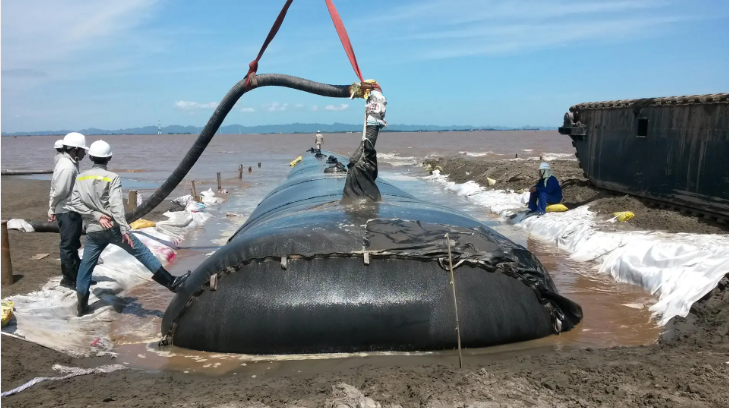
The construction methodology had to overcome soft soil conditions, withstand typhoons, and avoid disruptions caused by large daily tidal ranges. Two work platforms, totaling 4.1 km (2.5 miles) in length and approximately 26 m (85.3 ft) in width, were reclaimed above the highest tide levels to allow dry land construction activities.
Instead of using rocks, sand was dredged from nearby channels and stored in a temporary yard to fill the work platforms. Geotextile tubes provided an economical alternative to rock fill. The use of geotextile tubes reduced costs and allowed convenient installation using hydraulic sand delivery. This saved expenses and eliminated the need for long-distance transportation of rocks in challenging tidal and soft seabed conditions.
Soft ground and adverse tidal conditions posed challenges for heavy machinery used in foundation pile installation, bridge pier construction, and bridge section launching. The geotextile tube solution proved successful when the tubes withstood a direct hit by Typhoon Kalmaegi in September 2014.
2. 61 m Reinforced slope at Yanting Natural Gas Treatment Facility, Sichuan, China
The Yanting Natural Gas Treatment Facility project is located in Yanting County, Sichuan Province, covering approximately 320 acres. The site includes various zones such as production, auxiliary production, torch, and front plant areas, as well as functional spaces like warehouses.
Situated within hilly terrain, the project site features elevations ranging from 400 to 500 m and a varied, moderately complex topography. Geological formations consist of Quaternary and Jurassic strata, comprising rock types like silt, feldspar quartz sandstone, and mudstone.
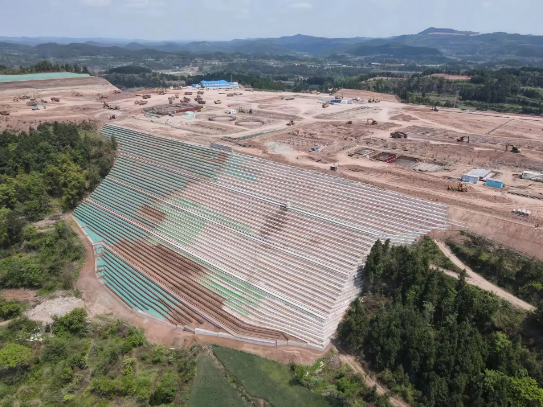
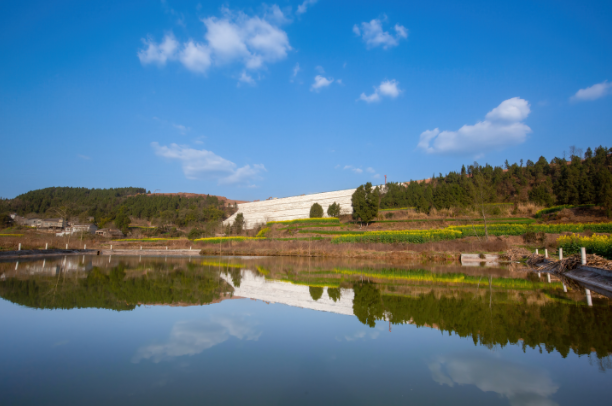
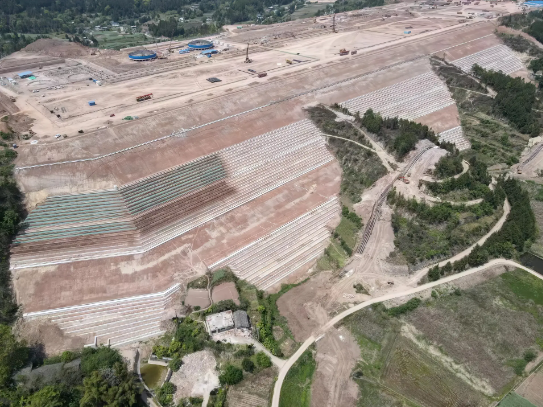
The initial construction methodology involved significant excavation and filling activities, altering the natural landscape and vegetation distribution. These activities posed risks of geological hazards such as landslides and collapses, as well as potential disruptions to groundwater recharge areas and runoff pathways, impacting the local environment.
A reinforced soil slope with high tensile woven geotextile was chosen as one of the solutions for the project. The slope extends to a maximum height of 61 meters from the foundation level to its top. Constructing a 61 m high reinforced soil slope is on the higher end of the scale for typical applications and required careful planning, design, and construction techniques to ensure stability and safety. The slope gradient of 1 vertical to 1.5 horizontal and 1 vertical to 2 horizontal was adopted.
To address soil instability issues, strategic approaches were recommended. These included systematic layering and compaction of fill materials, supplemented by reinforced soil with high-strength woven geotextile to enhance shear strength and improve slope stability. This approach not only minimized disruption to the surrounding ground and groundwater but also optimized the project area, reducing land procurement requirements and shortening construction timelines while enhancing safety measures for slope stability.
MIRAFI PET100-50 are high strength woven geotextiles made from high tenacity polyester yarns with long term high strength reinforcement properties. They were chosen to reinforce the fill slope as they offers high tensile strengths at well-defined strains over long-term design lives. Furthermore, they are highly stable under in-ground environmental conditions.
To reinforce the fill slope effectively, MIRAFI PET100-50 high-strength woven geotextiles were strategically placed at 0.5 m vertical spacing with varying designed lengths. A total of 910,000 m² of MIRAFI PET100-50 geotextiles were provided for this project, facilitating the construction of a reinforced soil slope spanning 1.2 km.
The successful completion of the 61 m reinforced soil slope-was attributed to the solution combining the performance of MIRAFI PET high-strength geotextiles and the sound technical expertise and experience of the team. The future phase of the project will involve vegetating the slopes to create a greener environment that will support the surrounding ecosystem.