
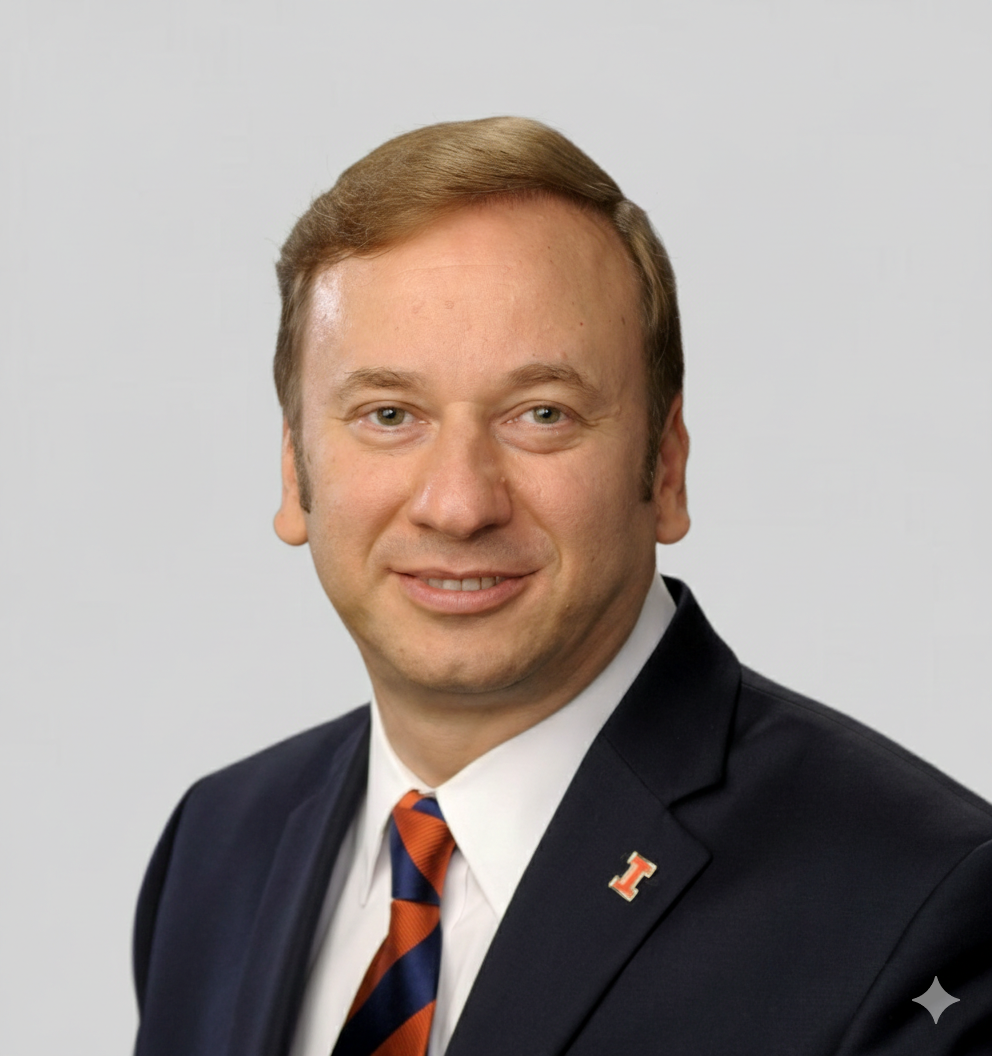
Dr. Erol Tutumluer
Biography
Dr. Erol Tutumluer is Abel Bliss Professor specializing in Transportation Geotechnics in the Department of Civil and Environmental Engineering (CEE) at the University of Illinois at Urbana-Champaign (UIUC). Professor Tutumluer holds the Paul F. Kent Endowed Faculty Scholar and serves as the Director of International and ZJUI Education Programs. Dr. Tutumluer has research interests and expertise in characterization of pavement and railroad track geomaterials, i.e., subgrade soils and base/ballast unbound aggregates, soil/aggregate stabilization, geosynthetics, advanced imaging techniques and applications of artificial intelligence and deep learning techniques to transportation infrastructure, structural health monitoring of transportation facilities using sensors, modeling granular foundation systems using innovative techniques, sustainable use of foundation geomaterials and construction practices for transportation infrastructure, discrete element analysis of ballast, dynamic response measurement and analyses of track systems, and mechanistic analysis and design.
Since he started as a faculty member at UIUC in 1996, Dr. Tutumluer has served as an investigator on over 140 research projects, graduated 28 PhD and 49 MS students, and authored/co-authored over 450 peer reviewed publications from his research projects. Dr. Tutumluer is a Founding Editor-in-Chief of the Transportation Geotechnics Elsevier journal and the immediate past Chair of the International Society of Soil Mechanics and Geotechnical Engineering (ISSMGE) Technical Committee 202 on Transportation Geotechnics; he served as TC202 Chair from 2013 until 2022. Dr. Tutumluer is a Distinguished Member of the American Society of Civil Engineers (ASCE) involved with both the Transportation and Development Institute (T&DI) and Geo-Institute and served as Chair of the ASCE Geo-Institute’s Pavements Committee (2006-2012). He is a member of the American Railway Engineering and Maintenance of Way Association (AREMA) Committee 1 on Roadway and Ballast. As a Council Member (2020-2026) of the International Geosynthetics Society (IGS), Dr. Tutumluer currently serves as Chair of the IGS Technical Committee (TC) on Roads, Railways and Airfields (formerly TC-Stabilization). Dr. Tutumluer is an Executive Board Member of the Transportation Research Board’s (TRB’s) Transportation Infrastructure Group, served as the Chair of TRB’s AKG00 Geology and Geotechnical Engineering Section in 2016-2023, and the Chair of TRB’s AFP70 Aggregates Committee in 2011-2016.
Dr. Tutumluer was the 2000 recipient of the TRB’s Fred Burgraff award for Excellence in Transportation Research; he also received TRB’s Geology and Earth Materials Section Best Paper Awards in 2009, 2012 and 2019, and TRB’s Soil Mechanics Section Best Paper Award in 2016. He was selected and honored with Yangtze River Scholar Award by China Ministry of Education in 2016. Dr. Tutumluer received Qiushi Distinguished Professor title bestowed upon him by Zhejiang University and delivered the Zeng Guoxi honor lecture in China in 2019. Dr. Tutumluer is the 2020 recipient of the ASCE T&DI James Laurie Prize in recognition of his career accomplishments for promoting Transportation Geotechnics field and the 2021 recipient of ASCE Geo-Institute’s Carl L. Monismith Lecture Award. In 2023, Dr. Tutumluer received an IGS Award in recognition of his significant contributions towards the use of geosynthetics in roadways, railways, and airfields. In 2024, Dr. Tutumluer received the ASCE T&DI Francis C. Turner Award for his contributions to the advancement of the knowledge and practice of transportation engineering and delivered the 5th Ralph R. Proctor Named Lecture of the ISSMGE. In 2025, Dr. Tutumluer was named Distinguished Member, the highest honor ASCE bestows, reserved for civil engineers who have achieved eminence in the profession.
Advanced Sensing and Modeling of Ballasted Track Deformation Behavior
Ballasted tracks are commonly used in shared corridors supporting both high speed passenger and freight trains in many countries. Ballasted tracks must be durable, stable, and able to withstand repetitive dynamic loading without excessive deformation or ride quality degradation, all of which need to be carefully studied. A full-scale ballasted track was constructed in the laboratory with a multitude of sensors installed in the 8-crosstie track structure physical experiment with the goal to study the detailed dynamic response and long-term behavior. Three different speed and axle load configurations were applied sequentially onto the full-scale ballasted track using eight actuators, which realistically captured both slow moving heavy freight and high-speed passenger train loads. Vibration velocities of ballast layer and crossties, dynamic soil stresses at the bottom of ballast and subballast layers, crosstie vertical transient and permanent deformations, and an innovative “SmartRock” sensor measured particle accelerations were all captured and analyzed. Following the same full-scale experimental setup, a Discrete Element Method (DEM) based simulation model of the ballast layer was also created for predicting measured responses and conducting ballast particle level analyses based on the advanced sensor data. Model parameter calibrations were first conducted to have the DEM model realistically representing laboratory situations. Surface friction angle and normal contact/shear contact were found to have significant influence on model predictions. This paper will present the predictions generated by the calibrated DEM model comprehensively compared with laboratory measurements including crosstie and ballast vibration velocity, crosstie permanent deformation, “SmartRock” acceleration, and crosstie velocity in frequency domain. A better prediction ability of track infrastructure behavior will help improve ballasted track designs and maintenance scheduling and lead to the development of accurate digital twin models.