
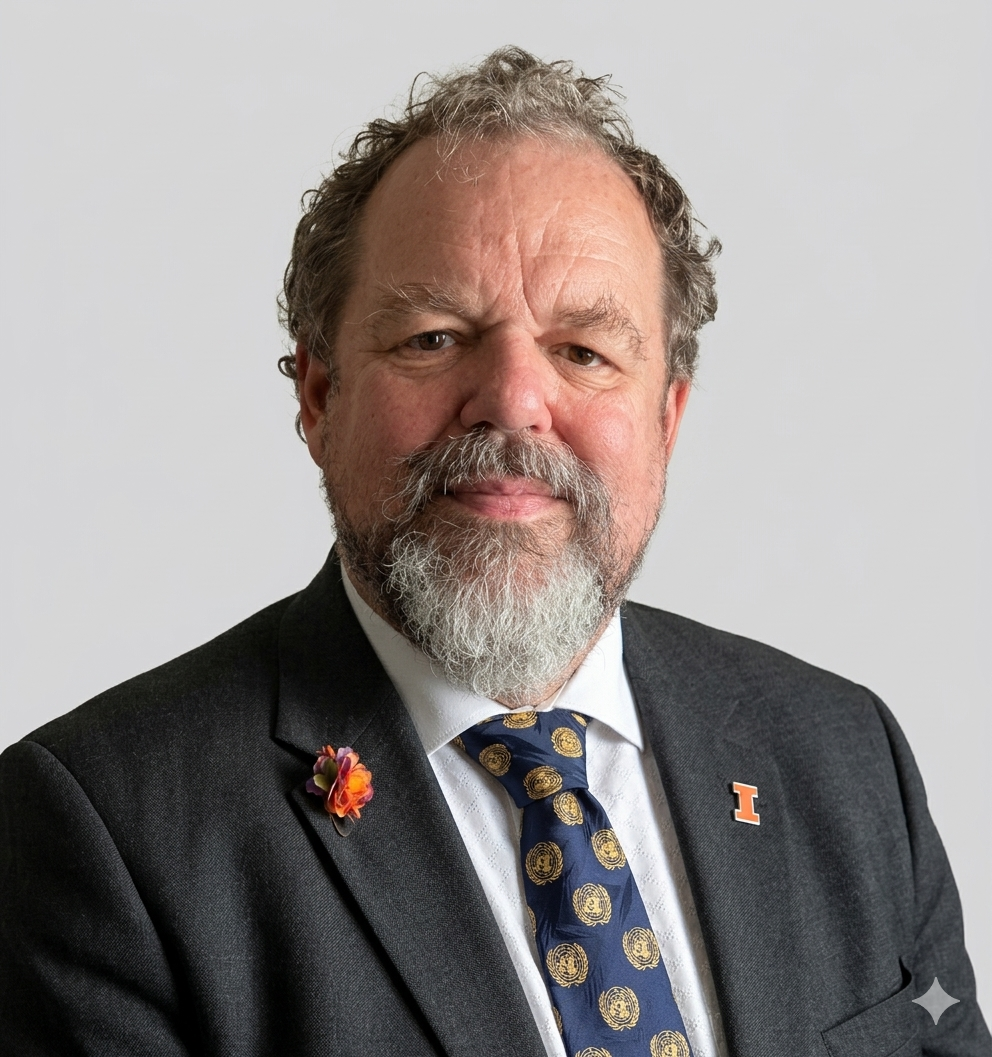
Prof. Arnold Dix
Biography
Arnold Dix is an Australian barrister, engineer, and scientist with more than 30 years of practice at the Bar. He served as President of the International Tunnelling and Underground Space Association (ITA-AITES, 2022–2025), the UN-recognised global peak body for underground engineering, and chairs the ITA–IAEA Special Interest Group on Geological Disposal Facilities (Radioactive Waste). He was Of Counsel to White & Case, and holds concurrently holds Visiting Professorships at Tokyo City University and MIT World Peace University Pune. He has held academic appointments as Associate Professor (Disasters) at the University of Western Sydney and Adjunct Professor at Queensland University of Technology.
He was the public face of the Silkyara Himalaya tunnel rescue (Uttarakhand, India, November 2023) — a 17-day operation in which 41 construction workers were freed from a collapsed Himalayan highway tunnel. Arriving as an unpaid volunteer, he coordinated the international rescue effort across extreme geotechnical, media, and political conditions. He has also served as Special Investigator to the Coroner for the Burnley Tunnel inquiry (Victoria, 2007–2011) and as an adviser to the Lakanal House and Grenfell Tower inquiries in London. His doctoral research examines why engineering crises are determined not by technical capability but by the quality of human communication under pressure, and what legal conditions enable honest expert intervention. His account of the Silkyara rescue, The Promise (Simon & Schuster, 2025), is the empirical centrepiece of that research. He was named Victorian Finalist, Australian of the Year 2026, and is the recipient of the Monash University Distinguished Alumni Award (2024), the NFPA Distinguished Committee Service Award (2022), and the Alan Neyland Award (2011)
What the Mountain Does Not Forgive: Disaster Risk, Communication Failure, and the Human Conditions for Safe Underground Construction in Vietnam’s Infrastructure Era
Vietnam is building underground at a pace and scale that is genuinely remarkable. Metro systems in Hanoi and Ho Chi Minh City, high-speed rail tunnels, and major civil infrastructure projects represent one of the most ambitious underground construction programmes in Southeast Asia. The engineering ambition is clear. What receives less attention is whether the social management systems surrounding that construction — the governance structures, the emergency response frameworks, the channels of communication between engineers, workers, decision-makers, and the public — are developing at the same pace as the projects themselves.
This paper argues that they are not, and that the global record of underground construction disasters provides specific and actionable evidence about where the gaps lie and what must be done.
Drawing on a cross-domain analysis of major underground construction failures and rescues — including the Silkyara Himalaya tunnel collapse (India, 2023), Chernobyl (1986), Fukushima (2011), and the Tham Luang cave rescue (Thailand, 2018) — the paper identifies a recurring pattern that transcends geology, project type, and national context. When underground emergencies occur, the technical response is rarely the binding constraint on outcome. What determines whether workers survive, whether communities are protected, and whether projects recover is the quality of human communication: honest, personally accountable, and free from the institutional pressures that in many documented cases have produced managed silence at precisely the moment when truth was most needed.
The paper introduces the Human Legitimacy-Based Risk Communication (HLRC) framework, developed through the author’s doctoral research and field experience, as a practical contribution to Vietnamese underground construction governance. The framework identifies six conditions for effective expert crisis communication — personal accountability, technical credibility, relational proximity, honest uncertainty acknowledgement, truth-telling under institutional pressure, and legal enablement — and applies them to the specific governance context of Vietnam’s expanding underground programme.
The paper concludes with concrete recommendations for embedding disaster risk communication standards into the planning, contracting, and emergency management frameworks of Vietnam’s metro and high-speed rail projects — not as an afterthought to engineering design, but as a foundational condition of safe underground construction.