
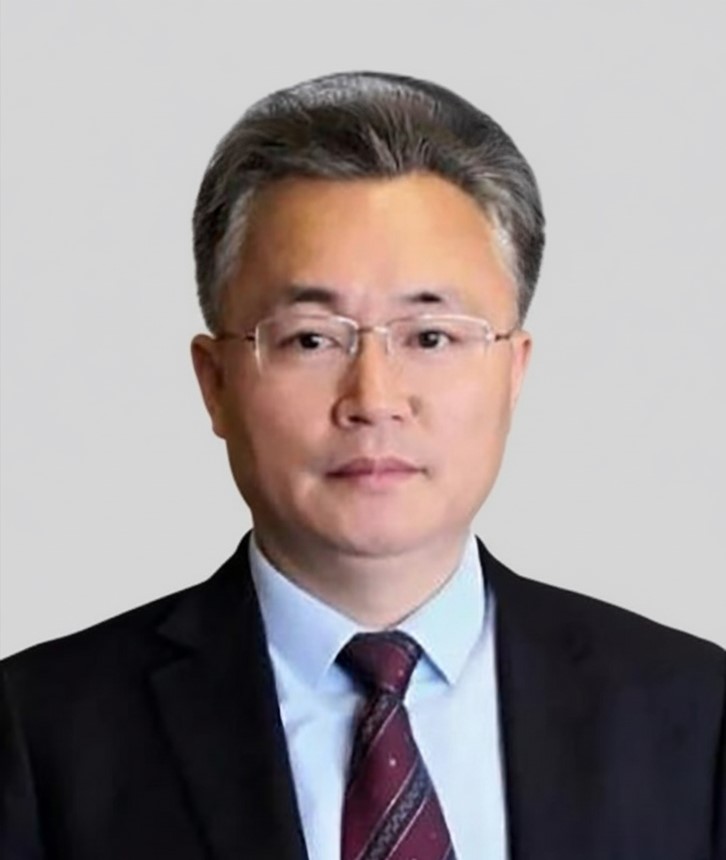
Prof. Gang Zheng
Biography
Professor Gang Zheng is the Vice-Chancellor of Tianjin University, Chair of TC219 of the ISSMGE, and Vice President of the Chinese Institution for Soil Mechanics and Geotechnical Engineering. He is widely regarded as a leading authority in geotechnical engineering, with research focused on the system performance of geotechnical structures, deep excavation in soft ground, underground construction in soft soil conditions, pile foundations, and ground improvement. Throughout his career, Professor Zheng has led several major national research programs, including the National Program on Key Basic Research Projects (973 Program), the National Key Research and Development Program of China, and the Key Program of the National Natural Science Foundation of China. His exceptional contributions have been recognized with numerous prestigious honors: the First Prize of the National Science and Technology Progress Award in 2019 for his work on theories, key technologies, and engineering applications of composite ground; the Second Prize of the same national award in 2015 for advances in safety control and cost-effective design of large and deep excavations; and the First Prize of the State Scientific and Technological Progress Award in 2014 for environmentally friendly supporting technologies for excavation. He was also the recipient of the R. M. Quigley Award in 2013 for his influential research on excavation effects on pile behaviour and capacity. With his distinguished academic accomplishments and significant impact on the field, Professor Gang Zheng stands as an outstanding keynote speaker for the conference.
AI-Empowered Geotechnical Engineering: Coping with Complexity and Uncertainty
With the construction environment being complicated, the discipline of geotechnical engineering has to confront the significant complexity and uncertainty of system behavior, especially heterogeneous and scarce in-situ monitoring data. Artificial intelligence empowered geotechnical engineering aims to address the intertwined challenges of increasing system complexity and data uncertainty in current practice. Artificial intelligence provides a methodological framework and toolchain for the situation, and the generative learning serves as a key technological breakthrough, with its technical paradigm shifting from the physics-driven to data-driven approach. By integrating real measurements, virtual simulations, and other supplementary data, the generative learning methods overcome the constraint of data scarcity during model training and enable improvement in the reliability and efficiency of predicting complex geotechnical behavior. This presentation will introduce the application of generative artificial intelligence in geotechnical engineering, which spans site investigation, geo-system behavior calculation, and design scheme optimization mainly in excavations and slopes. An excavation in Hangzhou, China using the novel intelligent early warning technology will be introduced in detail, showing the capacity of AI for coping with the complexity and uncertainty of design and construction. The work has been shown to significantly enhance the accuracy of geotechnical calculation and contribute to the safe construction in complicated environment.